Search This Blog

Showing posts with label Philosophy. Show all posts

Monday, 12 October 2026

Art Versus Science

Because I did Art/Architecture, Biology & English at A Level & didn't do Latin, I was told by my grammar school in 1963 I couldn't apply for University. It was a bit late to tell me because I was in my final year. Apparently universities didn't like mixed arts & sciences. Personally I think specialising too early is a mistake & a broad based education is better for the individual & society. So I did the next best thing & went to a college affiliated to London University which offered a 3 year degree equivalent course. These only came in in 1961, so it was quite new. The course specialised in art, music & drama as well as a comprehensive concentration on teaching. I am what I am today because of not going to university, so I am grateful.

The core education debate is "what is education for"? Should the driver be individual or societal? Should a child be allowed to pursue the subjects they like / are good at? Or, are the needs of society paramount, so they should be directed into areas society needs or lacks? You often hear the argument that some university courses are useless. Commonly criticised / low value degrees are - Creative Arts & Design (including Fine Art, Drama, and Fashion Design) - Performing Arts  (Music, Theatre Arts, and Dance - Mass Communications and Media Studies - Creative Writing and Film Studies). All of these so called "low value" degrees are arts. 

However in purely financial terms, the arts & culture sector generates approx 0.4 to 0.5% of the UK's GDP & the broader creative industries generate 5.5 to 5.7% of total economic value. The less quantifiable value of the arts is the benefit we all get from the various aspects of the arts & creativity. That can be in just looking & experiencing or in participating ourselves. I wonder if that even features in the figures I quoted. Think of all the art & craft materials & books sold to hobbyists.

I am a great believer in evidence, so science is important to me. More & more I feel that we need to be able to verify & challenge the information readily available to us from numerous sources, many questionable, if not totally unverified. We need scientists & empirically trained people to give us information we can trust. 

I suppose my argument is that in order to be the best that we each individually can be we need a broad based education for as long as possible. There is a heavy emphasis on STEM education (Science, Technology, Engineering, and Mathematics) which has historically sidelined arts & humanities.  Proponents of prioritising sciences contend that focusing on STEM aligns with labour market demands in high-growth sectors, and technology-driven economic strategies.

When students choose narrower subject combinations, research has shown that the proportion of students mixing arts and sciences has sharply drops, with exclusive STEM tracks doubling. There have been persistent funding cuts for creative & performing arts & a shift in the Strategic Priorities grant redirecting it to high cost healthcare & technical subjects. Governments are actively manipulating students choice towards a societal one.
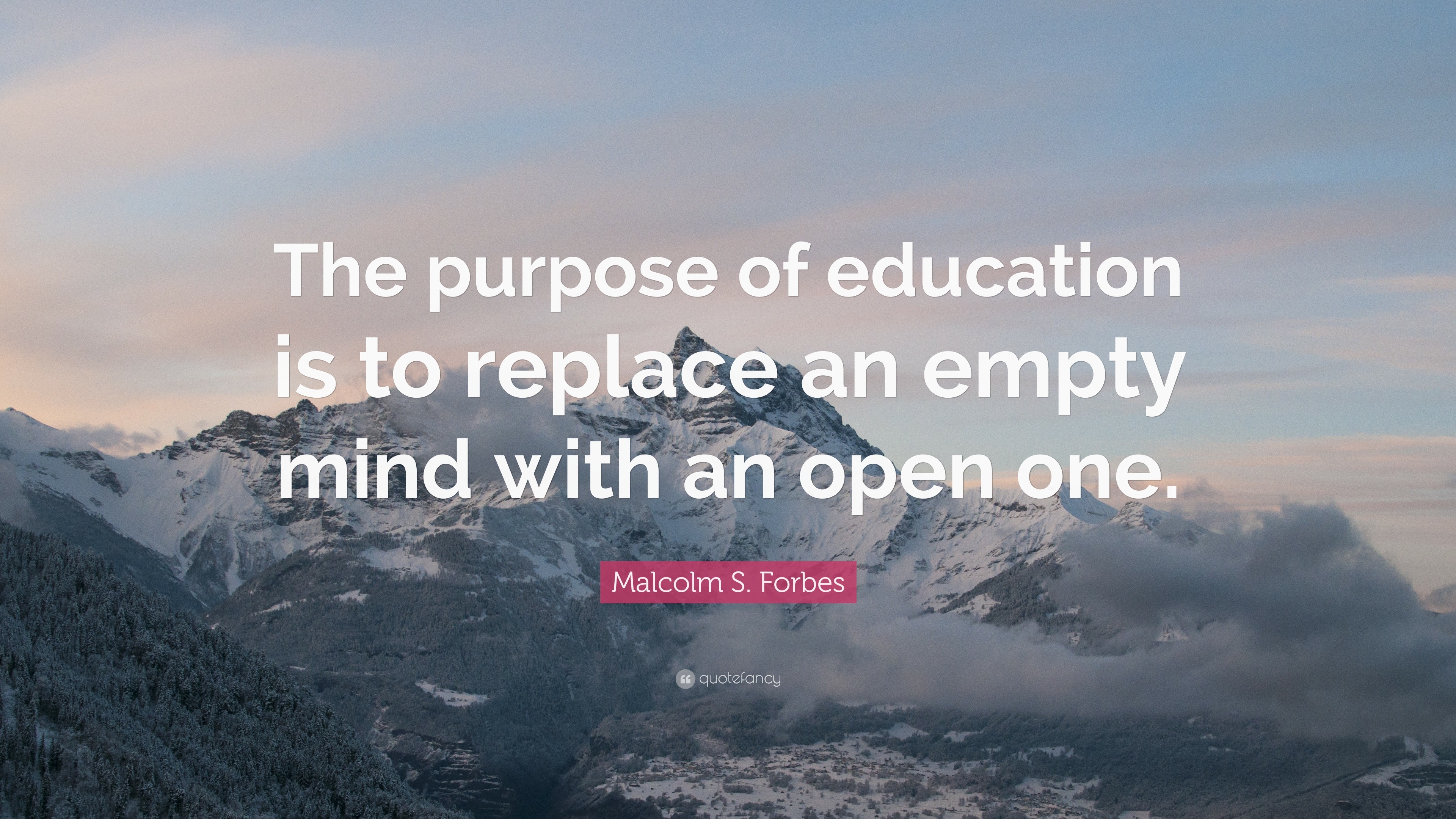
 https://quotefancy.com/media/wallpaper/3840x2160/36863-Malcolm-S-Forbes-Quote-The-purpose-of-education-is-to-replace-an.jpg

We all need both arts & sciences to flourish. Our children need & deserve a flexible, broad based, curriculum right through the education system, including tertiary. The broader our knowledge & experience the more flexible we will be. In a changing world that is really important.   


Tuesday, 6 October 2026

Memories & Remembering

Like many people my age my short term memory is getting very unreliable. I read in bed at night & have to go back a few pages every night to remind myself of what I previously read. If I watch a weekly TV series I have forgotten what happened in the previous week by the time it comes around again. I think that is all perfectly normal, however frustrating. I don't particularly worry about it.

I have never been able to remember much about my childhood. I suspect I have actually blocked much of it out because it wasn't easy. Even hypnotism didn't help me remember. By the time I left college at 21 I was really glad that I didn't have to return & live at home. I married & started a professional job in a different part of the country to my parents. 

Friends remember things about our friendship that I don't. My daughter remembers things about our lives that I don't. I tell myself it's because I tend not to look back. I prefer to live for today & look forward. 

Nowadays I need prompts to remember what is happening in my life. But I am an organised person & generally the prompts work. The most frustrating thing is not being able to recall words, even names of people I know well. I have a visual memory so I can see an image of the person / thing but can't remember the name. In common with many people I can set off to do something & in seconds the task has drifted out of my mind, so I'm walking somewhere to do something but don't know what.

There are things in everyone's life it is important to remember & things best forgotten. Dwelling on past arguments & mistakes really gets you nowhere. It has happened & cannot be changed. The most important thing is to not repeat the mistakes. To learn from them. On the other hand as you age you realise that good memories are little nuggets of gold to be treasured. 

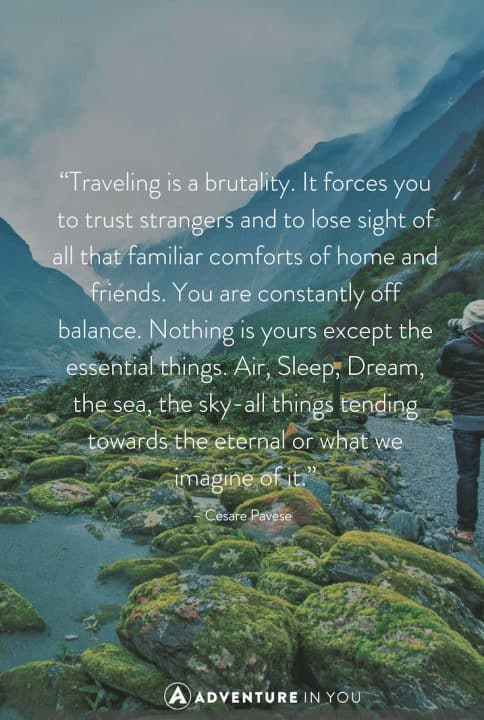
Now that I am less mobile & not able to travel to far flung places as I once did, I realise that my best memories are of wonderful journeys I had with my husband. We tended to focus on challenging walks in beautiful & varied landscapes. There is nothing quite like ascending to great heights & looking down from mountains. It gives you perspective. There is also nothing quite like meeting people who have a completely different culture & realising that we have more in common than the things that divide us. There is nothing like visiting sites of ancient civilisations & realising that we do not have a monopoly on creating & building. 

Travel does broaden your horizons & your mind. So these are the memories that I hope I retain. 

We now live in a time where we should all consider whether travel is justified because of the climate emergency. At the very least we should consider choosing land travel & avoid flying. Sadly many of the countries I travelled to are now unsafe because of civil unrest, criminal regimes & war. 

https://www.adventureinyou.com/wp-content/uploads/2015/04/travel-quote-484x720.jpg 

Times have changed & we have to change with them.    

Saturday, 3 October 2026

Being a Citizen

Being a citizen is a contract. It means being a legally recognised member of a country, state, or city & owing allegiance to it's government. In return the citizen receives full civil & political rights. Possibly that contract needs to be made much clearer, because it seems to me that too many of us are too ready to claim our rights & ignore our individual responsibilities. We are selfish. We want the benefits without contributing. 

Turnout at the 2024 general election was 59.7%, which was the lowest at a general election since 2001


Turnout at local elections is even worse.


It doesn't seem too much to ask that people go to a polling station & cast a vote for whomever they want to make decisions for them in return for the benefits of living in a democracy. You can even do it by post if that's too much effort!

Apparently voter numbers have declined globally since the 1960's. So it isn't just Brits. People least likely to vote are younger people, people with fewer qualifications, people with lower socio-economic backgrounds, people who were born overseas and people from ethnic minority groups. Exactly the people who I would argue need to be heard in this ever widening gap between the rich & the poor, the educated & the uneducated. A relatively small number of people in the UK may not vote due to political disengagement and/or logistical or bureaucratic barriers such as incorrect registration on the electoral roll.

To be honest I think it's more a feeling of apathy & lack of confidence that one vote matters. It does & will do even more if we get a fairer voting system than the current one.

I'm reading "Fahrenheit 451" by Ray Bradbury. It is so prescient & paints a picture of where this could so easily go if we don't all ensure that we know & understand what is happening in the world & the UK. Then we need to actually do something to try to make sure that decision making is in the interests of humanity & the world we live in.  


Wednesday, 30 September 2026

Value

Value can be what something is worth, or it can be what you personally value, which may not be valuable in monetary terms at all. Both are important. The latter speaks to your own values, what matters to you & what doesn't.

I'm just having a clear out in my house. I'm bearing in mind what William Morris said ""Have nothing in your houses that you do not know to be useful, or believe to be beautiful." So stuff is gradually being disposed of in one way or another. 


As you age, you refine the things you value. Over the years we all accumulate a lot of stuff. Much of it sits in cupboards & drawers untouched for months, even years. There comes a time when you have to question whether it deserves a place in your home. If you meditate on your own mortality you should think about the onerous job you leave behind for friends & family to get rid of all your worldly possessions. Giving them away while you are alive at least gives you the satisfaction of knowing that someone else needs or wants them & benefits from your gift. 

The issue of what you personally value is more complex & ethical. But again, I think ones moral values crystallise over the years. Although I don't have belief in any of the main religions, or even a god, I do value ethics & a moral code. It seems to me that the main thing we should all value is the sanctity of life, whether it is human or not. So we should care about what is happening to people all over the world. They may have cultural & religious differences to us, but that does not make them any less valuable or important. We should also value & protect all living species, if not for any other reason than everything is part of one huge symbiotic ecosystem. If we damage part of it, we ultimately damage ourselves.

I have been watching the excellent BBC series "Corridors of Power - should America Police the World" The one thing it shows us is that we do not value human life. If that is true what on earth do we truly value? 


Monday, 21 September 2026

Private v Public Health Care

I have strong ethical reasons for not wanting to pay privately for health care;-

  • Health, well being & life should not be commodities to be bought & sold. (Nor should utilities & public services generally in my view.) 
  • If healthcare is a fundamental right, access to it should be based strictly on medical need, not on an individual's wealth or ability to pay.
  • A public system, where the wealthy use the same system as everyone else, ensures a vested interest in making that system well funded, efficient & high quality. It encourages social cohesion.
  • Private healthcare means private clinics. Private clinics lure doctors, nurses & resources away from the public system, worsening the quality of care available to the less fortunate. (Just look at America if you don't believe that).
  • To my mind it is morally wrong to profit from human suffering, illness & vulnerability.
  • There is evidence to show that private healthcare can lead to unnecessary, expensive tests or procedures in order to increase revenue. The focus should simply be on patient health.
  • Jumping the queue undermines equality because the wealthy can bypass the problems experience by the "public".

In order to be even handed the counter arguments are that;- 

  • People should have the freedom to spend their legally acquired resources as they see fit. 
  • Choosing private care reduces the burden on publicly funded systems like the NHS.
  • Denying private care out of a strict desire for equality can result in what philosophers call "levelling down".
  • Individuals have a moral obligation to protect their own health and the well-being of their families.

Each of us has to examine our own conscience to decide on which side of the argument we stand.

I have now experienced 2 separate, but similar, unacceptable delays in getting appropriate healthcare from the NHS. Last year I tore a tendon in my right hand. I am right handed & it was excruciatingly painful. I couldn't touch it or move it. By the time the "urgent" appointment with the "Hand Clinic" came through, months later, the hand had healed itself, with the help of my Osteopath.

At the moment I have been waiting for over 6 months for bilateral, ultrasound guided, steroid, injections in my hips for Trochanteric Bursitis. This time I'm not so lucky, (despite the best efforts of my osteopath). I have deteriorated. A lot. It isn't just my hips that are affected now, my knees, ankles, back & neck are also worse. I am now concerned that by the time I get treatment - the wait is between 6-8 months, I will not recover the mobility I had.

But I doubt that I am a worst case scenario. There will be people in much worse circumstances than me. The NHS is not functioning appropriately, despite the best efforts of the people who work there. I imagine that they are unhappy at the state of affairs they work in & the choices they have to make. They are professionals who want to alleviate suffering & heal. 

At the moment they are failing too many people & don't have the resources, human, medical, or financial to do that. 

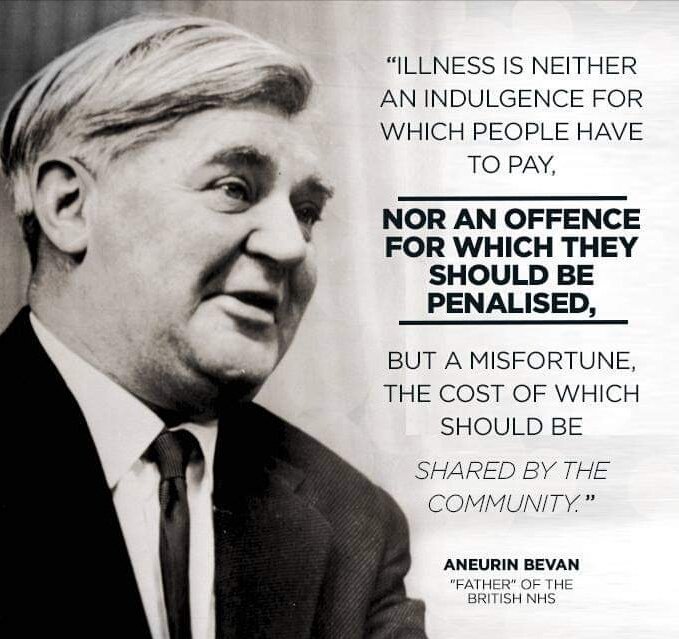
https://ewegottalove.com/wp-content/uploads/2020/08/Aneurin-Bevan-quote.jpg


Friday, 18 September 2026

Reasons to be Tearful & Fearful

I rarely cry. It takes a lot to upset me to that extent. The worst experience I have ever had, that made me cry uncontrollably, time & time again, was the death of my husband in a sudden, terrible, accident. Nothing personal has ever seemed as important or as bad since. I do occasionally weep a little at a sad book or film. But that isn't the same at all. The days of extreme emotions are largely behind me now. I'm calmer, more balanced in my 80's than I was in my 20's. I don't know if that is good or bad. 

We cry because of sadness, pain, strong feelings & emotions. So I am going to take crying because of death of a loved one or friend for granted. I am also going to leave out crying due to pain & physical personal suffering. I've done that too.

That leaves reasons to be tearful / fearful due to all the other circumstances affecting our world today. Things that should cause us all to feel sympathy & empathy. Things that should move us to want to take action;-

  • War & armed conflict - Ukraine, Sudan, Myanmar, Palestine, Lebanon, Yemen, Syria, Somalia, Haiti, Sahel.
  • Famine & severe poverty - Sudan, Palestine, Darfur, Haiti, Mali, Yemen, Nigeria, Somalia
  • Natural disasters - Nepal, Tibet, Columbia, Venezuela, Southern Europe (wild fires).
  • Violations of human rights - Gaza & the West Bank, Ukraine, Sudan, Afghanistan, Myanmar, China, Russia
  • Climate change & species loss - Everywhere 

Please notice the overlap of so many countries suffering more than one event. Then try to imagine what it must be like to try to continue living in those circumstances. If we are not able to do that, to put ourselves in the place of others suffering unspeakable events, we will not treat the suffering of others with the urgency it deserves. We will not take action. To my mind "collateral damage" is the most heinous euphemism in the English language.

We will continue to do what we have done so many times before & put national & personal self interest before the needs of others. Governments will continue to make decisions based on supposed national interest & we, the public, will allow them to do it. 

That, in my view makes us all culpable. 

So when governments try to remove our right to protest & speak out we should fight it with everything we have. Between 2022 - 2026 the UK government have introduced 3 Acts doing just that.

  • Police, Crime & Sentencing Courts Act 2022
  • Public Order Act 2023
  • Crime & Policing act 2026

These laws violate Articles 10 and 11 of the European Convention on Human Rights. Indeed there is a conservative policy to remove the UK from the European Convention on Human Rights.

Be very afraid. The threats we face are very real. The public need to engage & make the politicians listen to the will of the people.

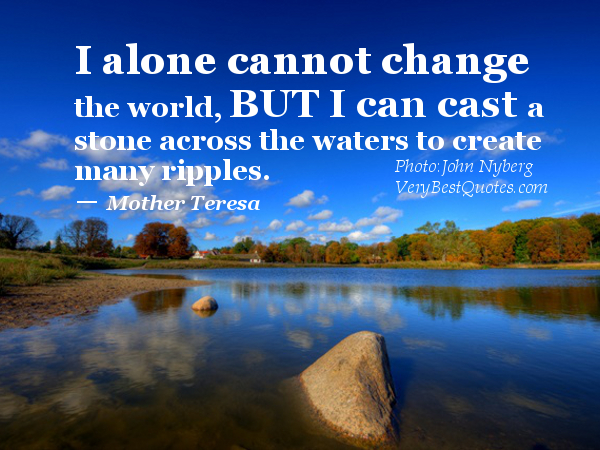
 https://cdn.quotesgram.com/img/19/10/65439706-I-alone-cannot-change-the-world-but-I-can-cast-a-stone-across-the-waters-to-create-many-ripples__E2_80_95-Mother-Teresa-Quotes.jpg 


Tuesday, 15 September 2026

Reasons to be Cheerful

I'm not sure I can differentiate between cheerfulness & positivity. I think I am positive, but am not sure I am particularly cheerful. But here goes, in the order they occurred to me;-

  • I am secure, at home & in the area & country in which I live
  • I am free to voice my opinions in public
  • I can vote freely without fear
  • I have friends & family I can trust
  • I can mostly rely on the basics of life - food, warmth, shelter, water (?), breathable air (?)
  • I have reliable, unbiased, sources of information - (providing I fact check)
  • I have reliable methods of communication with others - (at the moment)
  • I have leisure activities & things to occupy & interest me
  • I can be creative & appreciate the arts 

I'm sure I could think of more. I imagine you could too. It depends on what is important to you. 

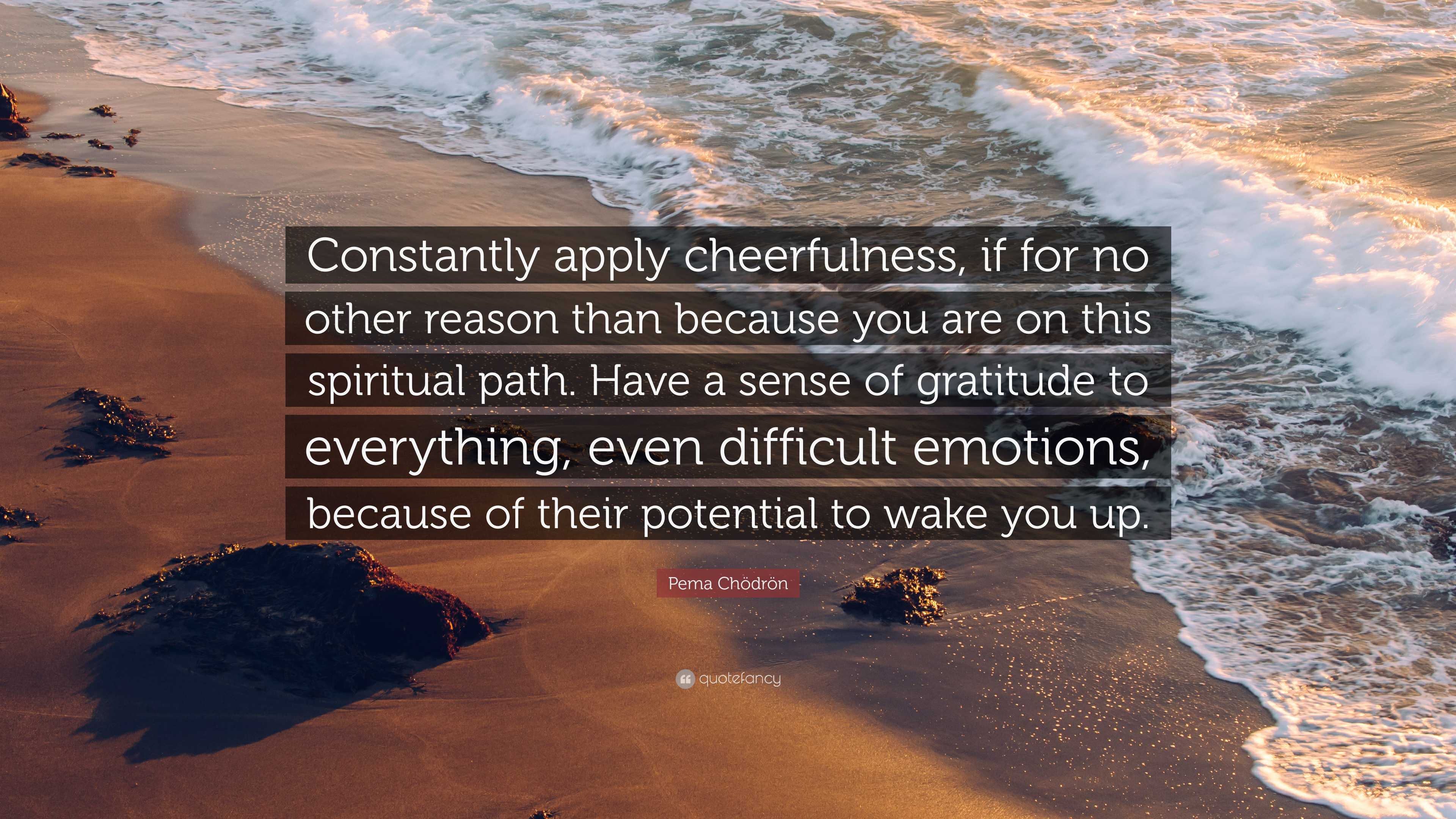
 https://quotefancy.com/media/wallpaper/3840x2160/9096180-Pema-Ch-dr-n-Quote-Constantly-apply-cheerfulness-if-for-no-other-reason-than-because.jpg

There are lots of things I have that I don't particularly need. How lucky am I? We all have stuff. Periodically I clear out & try to simplify my life. My life isn't basic by any means, it is a rich life. Not necessarily in monetary terms, although I am financially secure too.

What is the point of this post?

The point is that there are far more people who don't have the reasons to be cheerful than I do. 72% of people  live in countries facing biological resource deficits combined with below-world-average incomes, trapping large portions of the globe in ecological poverty. 72% of people face water security issues, with about 8% living with critical water insecurity. 43% of the world feels they can do nothing to protect themselves when facing a disaster. Millions live under zero physical security ratings, lacking basic protection from war, state violence or severe insurgency. There are nations rated as unfree.

Until the more fortunate nations understand & accept this, the world will not function as it should. We must disabuse ourselves of the idea that borders are fixed & not a man made construction that changes over time. Viewing the world from space changed the perceptions of astronauts. Several said that national boundaries & divisions vanish when in orbit, leaving just one fragile home. Where we are born, what we believe in, our culture, religion, fulfilment of needs, are all a lottery. We have little or no control initially, although some do change those parameters over time.

There are many things human beings deserve. A fulfilling life & happiness must be high on the list of priorities. 


Monday, 7 September 2026

Talking & Listening

I often listen to journalists interviewing politicians - Almost guaranteed to raise my blood pressure. So often they talk over each other, so you can't actually hear what is being said. So often they have completely different agendas & talk about completely different things. There are certain politicians who immediately make me shout at the radio in total frustration, usually those on the right.

As I've aged I've become more of a watcher & listener. There was a time when that wasn't the case - I had very strong views & was more dominant in conversations. I notice things now, that I probably didn't when I was younger. 

Good conversation is based on interest, asking questions, probing information & sharing ideas. I also think you have to like someone to be prepared to spend time engaging in conversation with them. I certainly can't be bothered now, unless forced to, to spend a lot of time making conversation with people I have nothing in common with or don't particularly like. On the other hand I am very happy to argue with someone I do like, who has a different perspective to me.

https://quotefancy.com/media/wallpaper/3840x2160/1838851-Jane-Goodall-Quote-Change-happens-by-listening-and-then-starting-a.jpg

I have noticed that it isn't unusual for some people to over share & monopolise a conversation. It intrigues me that they appear unaware that they are doing it. In order for me to be interested in a conversation I prefer to actually know the people being discussed. Or there needs to be an interesting general point being made. I am sometimes surprised at lengthy, one sided, conversations about people I have never met. 

I am also surprised when a conversation centres around the life of the person I am talking to, with little or no enquiry about my life & what I have been doing. A good conversation is a two way exchange that is mutually interesting. 

We are social animals. We need to meaningfully interact with each other. It is important that we are able to talk & listen to many voices. We need our views to be challenged. None of us is always right. Life is nuanced, there are always shades of grey & different perspectives. 

Communication via WhatsApp, texts & emails isn't the same as actually having a face to face conversation or even a phone call. I am quite concerned how polarised, insular & dogmatic we seem to be becoming. Tapping is replacing talking. 

Friday, 4 September 2026

Learning & Education

There is a tendency to believe that education takes place in schools & universities. Teachers & lecturers are the people responsible for inculcating information into young peoples minds. There is also a tendency to believe that we all know what education is because we have all been to school. I completely disagree with both premises.

https://images.template.net/399718/Nelson-Mandela-Quote-on-Education-Template-edit-online.png 

The evidence is that the first 5 years of life are the most critical period for rapid brain development and foundational learning. These early years build the core architecture for all future learning, behaviour, and health. It is critical that parents have the skills to teach their children. Out of 8,760 total hours in a year,  school attendance accounts for about 14.1% of total time (roughly 30.8% of a child's waking hours assuming 11 hours awake daily). In simple terms more than two thirds of a child's time, when in full time education, is spent at home. Parents are a crucial part of education & learning.

Children also learn from their peers, from TV, from their mobile phones & computers. Even from books. Nowadays children have access to more information than ever before. There isn't any reason why we shouldn't have the best educated children ever. 

UK children today attain higher formal academic qualifications on paper than previous generations, but persistent systemic inequalities mean many still face profound learning divides. The Institute for Fiscal Studies shows that a child's family income and social background remain deeply tied to their school achievement. 

25% of children in the UK do not meet the expected national standards in reading and 25% do not meet them in mathematics by the end of primary school. We must accept than not everyone falls within or above average intelligence. Scores falling below 85 / 100 are traditionally considered below average, representing roughly 16% of the population. So we must provide extra help for those children. Conversely 14% are above average & between 2 - 5%of children can be classified as gifted. I would argue that we should also provide extra challenges to stretch those children. Education isn't "one size fits all". 

I believe in lifelong learning. I have definitely learnt far more post further education than I learnt in 16 years at school & college. My concern is that our model of education, although it has changed substantially since I was a headteacher, needs a really close examination. As we move through the 21st century we must recognise the huge changes in life & the world of work. I suspect that we are only at the beginning of drastic & serious change to our world. 

I really don't think we are ready for what might come. The model we are following is already outdated. There are simple questions we need to answer. "What exactly to we need to actually know"? "What skills do we need to have"? "What personal attributes are important"? "What should the curriculum include & what can we discard"?

 https://content-management-files.canva.com/ab3ea0b1-21af-4bc0-b491-aa3a1f081446/WhiteSimpleBorderedForMenQuotesInstagramPost.jpg

We need to get ahead of this, but there are so many competing political issues demanding attention I'm afraid we won't be able to. 

Tuesday, 1 September 2026

Security

My doors have 3 point locking. My windows all lock. I have a doorbell that tells me when anyone steps on my drive. My property is delineated by fences. I'm not aware of any threat. I am secure. I live in a relatively safe neighbourhood in a relatively safe country. I am very fortunate. 

But all of that could change in an instant. None of us should take security for granted. There are any number of possible threats of different levels of seriousness. I could trip & fall down the stairs. I could forget to lock my doors & be burgled or worse. The house could be struck by lightening. There could be civil unrest & riots. Russia could attack.....

My point is that we all tend to be complacent. "It won't happen to me". We do take our security for granted. 

We see dreadful events unfolding in all parts of the world. From natural disasters, to disease & war. We see people commit crimes against each other. In today's world we see events instantly on TV, our phones & computers. We are informed. Correspondents & journalists rush to events even as they happen. We ourselves record & share live events on social media.

We cannot say we do not know what the threats are.

What is it about us humans that allows us, in the face of almost instant communications, to compartmentalise what is happening to other people? We can seemingly put the information in a box inside our brain. We can sympathise, even empathise, but so many of us can also ignore even deny reality. 

Dealing with trauma is complex. We have to process our shock. Adrenaline prepares us to fight, flee or freeze. We experience emotions - sadness, anger, fear, guilt. I just wonder whether we are becoming less able to feel enough. Whether we are viewing events without really feeling because we feel powerless. Especially feeling enough anger about injustice & unfairness.

I have worked, briefly in Nepal. It is one of the poorest countries in the world. 20% to 25% of Nepal's population live below the national poverty line. It is a beautiful but difficult landscape. Mountainous terrain limits trade, infrastructure development, and access to schools or medical care. A large portion of Nepal's working-age population migrates abroad for work, sending money back home to support families.  A majority of rural citizens still rely on basic farming rather than commercial industries. 

It is not a country that can cope alone with the devastation of the floods of last Wednesday. Most Nepalese live with insecurity of one sort or another. The event is a graphic example of the climate emergency we are all living in. A glacier melted & collapsed. Permafrost is being weakened by warming. No one will be secure from climate events. But the people who have done least to create this problem are the ones whose lives are most affected. 

Politicians make capital out of population movements & want to control our borders. What does that mean about our humanity? If we live in relatively secure areas of the world are we going to "repel all borders" in order to protect our security? Or are we going to help. Are we going to share? Are we going to be generous?


I don't know the answer, but I fear the possibilities. 


Saturday, 29 August 2026

Reflections

I look at my face in the mirror every morning when I wash & brush my teeth. The face I see reflected is reality, but my mind still believes otherwise. I know that I am wrinkled, my skin is paper thin & dry, my hair has lost it's auburn colour & I have eyebrows which have a mind of their own. I understand that I am an old lady, but my mind is still working, still interested & curious. Fundamentally I am myself as I have always been, but better - I hope. I know more, through experience & living. Also from reading, watching documentaries & research generally.

Because I am more sedentary due to the limitations of my body, I do think more. This blog has changed over 15 years, starting in February 2011, with a current total of  1,219 posts. Obviously I am very opinionated! It started because I missed discussing life, philosophy & politics with my husband & needed to find a way forward on my own after a lifetime of marriage. Now I'm amazed to see that my blog has reached as many as 15.5 thousand people in one week.

I have changed & the blog has changed. I could not have foreseen how my life, the UK & the world would change. I was interested in climate change & politics at the start, but both of those issues have become even more worrying today. Plus we now have wars, death & destruction to contend with. 

I have just been recommended to read "The Beginning Comes After the End" by Rebecca Solnit, who also wrote "Hope in the Dark". I will read both, but I am losing faith. I have always been a glass half full person, thinking that if I believed I could do something, I could. Belief is really important. Now I am deeply concerned. I feel we have made society too complex, we have damaged too much, we endlessly fight over territory & resources, we make decisions without considering consequences...
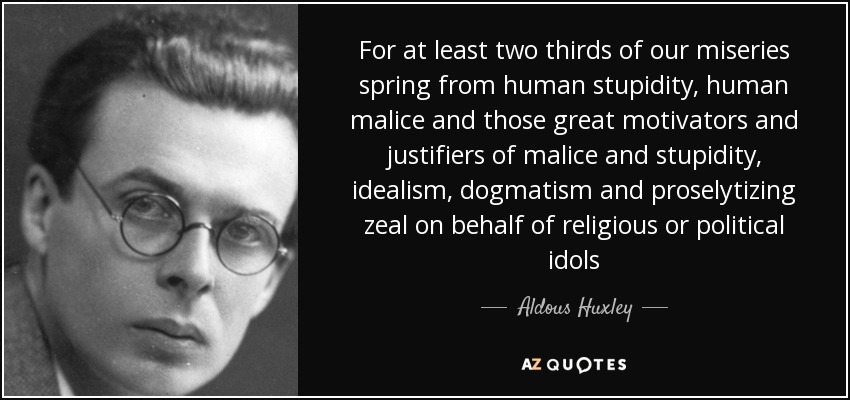
I reflect & I despair of the human race. I cannot imagine what my 21 year old twin grandsons will inherit. Or rather I don't want to, because it is too dire. I never thought I would think like this & I'm glad I'm 81 with limited time left. 

When I look at some of the comments on Greenpeace or ClientEarth posts on Facebook I am speechless at the complacency & ignorance. We do have the capacity to turn this around, to make meaningful change, but it is an uphill struggle. In order to do that everyone everywhere has to buy into a different way of living & sharing this planet. 
 
Unfortunately I just think we are now over the tipping point & the forces against us are too wealthy & too powerful. Self interest is prevalent both in multinational companies & individuals. We have lost our sense of real community. We are insular & self serving. Many people feel they have no agency, no power or control. I even question if we can call ourselves democratic. 
 
We all need to reflect before it is too late. We all need to change fundamentally or we will destroy the wonderful world that we have. I am not Cassandra - She accurately predicted future disasters or negative events but was ignored or disbelieved, but I can see the direction we are going in.
 
https://encrypted-tbn0.gstatic.com/images?q=tbn:ANd9GcS-TzqR1BW_rshGL-iLZ3kSL8eJqmed9Sti5rdlj88UYw&s 
 
I hope it isn't too late.  


Wednesday, 26 August 2026

Consideration & Politeness

When an oncoming car gives way for me I raise my hand in acknowledgement. It's a second of politeness. I don't even need to take my hand off the wheel. I expect oncoming cars to do the same when I give way. Not sure what the % of people who do is, but a lot of people don't. Given our congested roads today I think both giving way & saying thank you are such small gestures I can't understand why so many people don't do it. Are they just rude or arrogant, not concentrating, or are their minds on other things? Who knows. But it is irritating.

Both data and public perception suggest that people have become more impolite in the 21st century. A Pew research paper found that nearly half of adults believe public behaviour is ruder now than it was before the pandemic. They found that social isolation during COVID-19 caused interpersonal skills to atrophy. Also on line disinhibition has changed manners & etiquette. Traditional rules are disappearing. Heightened political and social divisions have spilled over into everyday interactions, reducing baseline empathy toward strangers. 

The Pew survey defined rudeness as public behaviours ranging from cursing or playing loud music to smoking & taking photos of people without permission. There seems to be a "tit for tat" response, insults or rudeness provokes insults or rudeness & negative interaction can escalate. Hopefully not if you are in a car though. Although I do remember extreme examples of road rage. 

There have always been rude people. Another piece of research said that " these individuals are amoral (or immoral) hotheads who refuse to accept criticism or correction from others. They may also—though less reliably—be low in behavioural inhibition, high in behavioural activation, “blirtatious (quickly and openly expressing their thoughts and feelings to others), narcissistic, and/or Machiavellian".

 https://jokesoftheday.net/jokes-archive/2015/05/21/Being-rude-is-easy.jpg.400.jpg

I wondered if rudeness is learned behaviour. As I thought it is. Children learn by imitation & modelling. So the parents or guardians have a huge impact on behaviour. Apparently rudeness spreads like a virus. If others in your group are rude you copy because you want to belong. 

The corollary is that manners, consideration & politeness have to be actively taught to children by those nearest & dearest. In my experience if you smile & are polite you stand more chance of receiving similar behaviour. Being rude, abusive, inconsiderate & impolite will just result in that being the behaviour you receive.

It's a vicious circle which is all too common.    

Saturday, 22 August 2026

Medicalising Normality

The Channel 4 documentary "The great ADHD Myth", which has proved controversial, was presented by the NHS psychiatrist Dr Max Pemberton, who concluded that ADHD was a “social construct” rather than a medical condition, and schools should better support children rather than doctors medicating them into fitting into a supposed norm. I haven't watched it yet, but I have been wondering whether we have over medicalised human behaviours that are actually within a "normal" spectrum.

If we have learned anything about our species with the development of science, it is that we humans are infinitely variable in how we think & behave. I have lived through the period when not being heterosexual was illegal. How ridiculous that seems now. Now we have LGBTQIA+ definitions of sexuality. I have to admit that I don't fully understand all of that. But it clearly makes my point that there are huge "normal" variations in sexuality.

I have also lived through much of my life when the common response to being anxious or depressed was something akin to "that's life - get over it". Stoicism & resilience were the answer. Now we have several neurodiverse conditions - Autism, ADHD, Dyslexia, Dyscalculia, Dyspraxia & Dysgraphia. Again, I can't claim to understand what each of those involves, but I do know that one size doesn't fit all. There are different levels in each individual. Just heard of a new one - Rejection Sensitivity Disphoria - an emotional and physical response to real or perceived rejection, criticism, or failure!

My point is that being human is complicated, mentally, physically & emotionally. For every difference in thought & behaviour there is a huge range of "normal". I'm really not at all sure that compartmentalising & diagnosing people has helped us. Which brings me towards accepting that the medicalising of difference may well just be creating problems. 

There was a time when gay people were systematically persecuted - imprisoned, forced into chemical castration & given electro convulsive therapy. Now, hopefully we know better & are more tolerant of something that is also widespread in other animals. 

As to neurodiversity, why can't we just accept the we are very complex animals who are often "wired" very differently. Why do we have to diagnose & medicalise conditions which seem increasingly to just be part of a hugely diverse picture of humanity. Why can't we just accept difference exists. Why do we want to be homogenous, part of the crowd, not outsiders? We give people stimulant drugs like Ritalin & Amphetamines. We also give them non stimulants, anti psychotics & SSRI's. The list is endless. There are always side effects with drugs. Virtually all medical drugs are toxic in some way. Many of these drugs are being given to children & young people. 

I worry that we are just creating huge profits for the very wealthy Pharma industries & doing unknown harm to the people who are prescribed the drugs, because we don't have the time or the money to counsel & support & treat in other ways. 

https://quotefancy.com/media/wallpaper/800x450/710501-William-Osler-Quote-The-good-physician-treats-the-disease-the.jpg 

Tuesday, 18 August 2026

Wealth Distribution & Inheritance

On & off I've been listening to BBC radio 4 "Tony Hawks is Giving Nothing Away" https://www.bbc.co.uk/programmes/m002fl03  It is very interesting & fits with what I have thought for years. I simply don't believe in inherited wealth for many reasons which are explored in the programme better than I can. 

In simple terms inherited wealth perpetuates wealth & land ownership in the hands of a select few. If the inheritance is substantial it can change the life of the inheritor, who did nothing to earn the money & land & will never need to work. On the other hand if the money & land is given to charity for example it can do so much good & benefit far more people. 

I have seen situations where offspring feel that their parents money is their right & due. I have also seen situations where one child is substantially better off than another & isn't prepared for the parent to give more to the less wealthy child. Inheritance does not breed altruism.

So I made the decision years ago that my only child would not inherit everything I leave behind. I am fortunate financially, but my husband & I earned everything we have through a combination of having good jobs, working hard to get senior positions & living fairly frugally. 

I think the really important thing about inheritance is that parents are open about what they intend to do & discuss it with their children. The reasons behind the decision are really important. After my mother died I discovered that she had cut me out of her will. Although there wasn't much to inherit I was devastated. It had a hugely emotional impact even though we had a difficult relationship all my life. I was an only child. It was a slap in the face.

My daughter has known what my will would be since before I wrote it. We discussed it & I have written a letter to her expressing my love & pride in the person she is with the will. She will inherit what I consider a reasonable amount, but the rest will be distributed to several charities. I think she understands & is happy with the decision. While I am alive I try to be generous both to my small family & to charities. I'm alive to see the benefit of doing that.

So I do not have any understanding whatsoever of the very wealthy who seemingly are only interested in amassing even more money & possessions for themselves. The net worth of individual multi billionaires eclipses the GDP or national income of small to mid sized nations - e.g. Elon Musk or Jeff Bezos hold personal net worth figures surpassing the nominal GDP of countries such as Hungary, New Zealand, or multiple smaller developing economies.

https://fortune.com/2025/04/02/world-record-number-of-billionaires-wealth-higher-than-most-gdp-despite-stock-market-bloodbath/  

Money can do so much good. It should not be concentrated in the hands of a few. Our relationship to wealth has become completely unbalanced. How have we reached the point where so few have so much wealth & therefore power? I would love the very wealthy to discover the joys of philanthropy. It's good for the soul. 

https://www.azquotes.com/image-quotes/Quotation-John-F-Kennedy-If-a-free-society-cannot-help-the-many-who-are-15-61-68.jpg 


Friday, 14 August 2026

Work & Unemployment

According to the song from Cabaret "money makes the world go around". We need it for basic survival - food, water, a place to live etc. Society needs it for financial exchange, jobs, trade, and public services etc. Financial gain often motivates people's choices and actions more than other values do.

https://quotefancy.com/media/wallpaper/3840x2160/1609157-Ellen-Wilkinson-Quote-Unemployment-is-bigger-than-a-political-party-It-is-a-national.jpg

Sunday, 9 August 2026

Justice, Joint Enterprise & Early Release

The case of PC Andrew Harper is distressing & emotive & is causing debate in light of the Early Release Scheme due to prison overcrowding. In 2019 Harper was killed when responding to a burglary, (theft of a quad bike). 3 young men, (one 18 the driver & two 17 year old minors) were found guilty of manslaughter & were given 16 & 13 year sentences. A 21 year old was also charged with conspiracy to steal. Only the driver pleaded guilty to manslaughter. The sentences were reviewed and upheld.

The 2 younger passengers are eligible for early release under the Early Release Scheme. Unsurprisingly this has created much discussion about this case in particular & wider issues regarding criminals whose actions result in the death of any police officer or first responder.

I discussed this with friends over coffee this week & also with a different friend afterwards. There were very differing points of view. 

What happened to PC Harper & the impact on his family, friends & colleagues cannot be overstated. But the issues raised are at the least interesting legally.

The crux of one point of view is - could the passengers actually have stopped the driver continuing? The view of my coffee morning group was yes passengers can speak up, but they can't safely physically grab the controls because they could cause a crash & endanger life. If the boys warned the driver & he ignored them that makes his actions more serious. If they encouraged him that makes them legally liable too. I haven't found any evidence as to where the boys were sitting in the car front or back. If they were in the back it seems unlikely they could do much physically. I also wonder what evidence there was as to whether they encouraged him or did tell him about Harper & tell him to stop. I don't know whether or when they were all aware that Harper was being dragged. I have since seen the footage of the two boys attitude on TV which was appalling & did them no favours. 

My other friends point of view is that all three of the boys were equally responsible. So basically, as in murder, it was joint enterprise. This allows more than one person to be charged with a crime even if only one person directly did the harmful act. The others helped, encouraged or planned the crime. Again I haven't found anything to support or deny this idea. My assumption would be that all three must have planned the theft of the quad bike, but the killing of PC Harper was not murder because it was not premeditated & planned. It was a dreadful accident. The important element is if & when the boys all knew Harper was being dragged & what, if anything they did about it once they knew. 

 https://microless.com/cdn/products/b0e007fefa6021c7e3a90a74f980ad2a-md.jpg

I wish I knew more. But more importantly I think that in order for the public to make an informed decision on the idea of Early Release for criminals like this, they need to know much more of the background to the crime. Much of what we are seeing on TV & in the media is lacking in any detail other than the very sad & emotional bare bones. 

Our prison system is frighteningly close to collapse & has been in an appalling state for years. I resigned from the Independent Monitoring Board of Gloucester prison in 2013. So I know that for a fact. Privatisation was coming into the system & things went downhill from there. There have been decades of underfunding & mismanagement in the justice system. We are now seeing the results of that.

I was also a magistrate for years, so have some understanding of the whole justice system. My conclusion at the end of my time was that there is a lot of law, but not an equivalent amount of justice. The UK locks far too many people up. England, Wales & Scotland have the highest per capita rates in Western Europe compared to nations favouring rehabilitation and community alternatives.

There are always alternatives & different ways of doing things. The UK really needs to examine the justice in our justice system.  


Friday, 7 August 2026

Dogmatism, Dialogue & Politics.

It is so easy to see things in black & white terms. There is only one god & it's mine, not yours. You are deluded & will not go to heaven. I have been saved & will. Some politicians are convinced their party has the only workable policies. I watch someone on the far right like Zia Yusuf for example & despair. The arrogance & bombast precludes any semblance of listening to a different point of view. The mantra seems to be shout louder & over the top of anyone disagreeing. Interrupt anyone voicing a different view. Steamroller your opinion into prominence. No semblance of dialogue.

https://www.azquotes.com/picture-quotes/quote-for-at-least-two-thirds-of-our-miseries-spring-from-human-stupidity-human-malice-and-aldous-huxley-38-94-10.jpg 

It is important to have conviction politicians. It is important that they believe in their policies. As long as those policies are backed up by evidence & have been properly researched. But policies also need to be inclusive, in the interests of the people as a whole, across the strata of the public. They should not benefit a particular group, unless it it to redress an unfair imbalance. 

Our education system values dialogue. Universities are based on tutorials & debating societies. My friendship groups are interesting because they are made up of such a diverse selection of people - different age groups, different ethnicities, male & female, different religions & none, different political affiliations, different financial situations.... But the thing I value most is that I can disagree with friends & still value them & remain on good terms. Sometimes they actually do persuade me to change my mind. (Not a lot though! It's taken me 81 years to really know what I think, what is important to me)

I worry we are losing the ability as a society to value difference. We are becoming more & more polarised both as a society & as individuals. There are far more grey areas, far more nuances, than we allow for. Circumstances change. We really need to listen more & be prepared to change our opinions. We need to understand that our opinions are simply thoughts our brain has created. They should not be set in stone. Our brains are fallible & make mistakes. 

Mistakes are good, so long as we learn from them. Changing your mind is acceptable. Your mind is not pre eminent. Others might well be better. You are not omnipotent, whether you are a low paid worker or a multi millionaire. 

Tuesday, 4 August 2026

Waiting Lists

When I was young I was very impatient. I was a person of lists & priorities. I was very organised & believed that I could do things better than anyone else. How self confident, how arrogant. But it did get me to the top of my profession. I wasn't good at waiting though, even in supermarket queues. I made decisions & took action quickly. So I imagine some things could have been done better & mistakes were made. 

Now I am much more patient & tolerant. I have learned not to expect things to be done yesterday. Just as well because that isn't how today's society works. I seem to spend a disproportionate amount of time waiting for people to rectify their mistakes. Mistakes that frequently should not have happened in the first place. I could give you a list, but it would be very boring. But I resent the amount of my time it takes & I still naively have expectations that people will do their job properly.

The whole concept of a "waiting list" in healthcare seems to me to be unacceptable. Yes I know that the NHS need ever increasing amounts of money to meet today's needs. I also know that we need more medics & more hospital beds. Health & social care are inextricably linked so we need to sort that out too. However those problems have not appeared overnight. They are the result of decades of mismanagement, lack of effective communication & sharing of good practice, a hierarchy of fiefdoms that don't look at the patient holistically.....It's a behemoth & won't be sorted anytime soon. Especially as we are effectively bankrupt & there hasn't been the political will.

A waiting list sounds innocuous, but it isn't. A waiting list means patients trying to live with ill health, pain, fatigue & disability at home. It means patients gradually getting worse even past the point of recovery. It means family, friends even neighbours trying to care for someone who need professional care. Some will die.

 https://t4.ftcdn.net/jpg/06/93/52/51/360_F_693525193_s9u7R65Kq0a195U1dMCRLCexeFVfz2d3.jpg

Two personal examples, fortunately not life threatening. 

Last year I tore a tendon in my right hand. (I am right handed & live alone). It was excruciatingly painful. I couldn't move it or do anything with it & was terrified someone would bump into me. I was referred urgently to the "hand clinic". By the time the appointment finally came, months later, this year, my hand had recovered on it's own. I was told that "hand clinics" are the busiest orthopaedic clinics & routinely have very long wait lists. 

This year I have had bilateral Trochanteric Bursitis in my hips. The flare up of pain, fatigue & disability at it's acute worst meant I crawled upstairs on hands & feet, could not walk the 5 -10 minutes to my local shopping centre, could not stand for any length of time to prepare food & couldn't sit down & get up from a chair or turn over in bed without real pain. At it's mildest I am still very limited but it's bearable. Although the consultant put me on a cancellation list for ultrasound guided steroid injections into both hips, I know there is a 6 - 8 months waiting list.

I'm not going to die from any of this. I'm resilient & I can cope. My point is that although I am not in the worst waiting list situation, I do think this is unacceptable. And it is largely hidden. Because people on waiting lists have no choice, but to cope. 

Unless they can pay & that is against my principles. 

Wednesday, 29 July 2026

Westminster - The Seat of Government?

I have quite strong views about this topic. I think they are very logical, but I know that they probably won't be universally popular.

For starters I think we should sell off the Houses of Parliament & permanently move the seat of government to somewhere more central in the UK. That would give us the opportunity to have a purpose built, much better designed, far less adversarial, setting for decision making. We need a circular design that isn't as sectarian. Just like Scotland & Wales. It seems to work very well there. I've mentioned before that the cross bench adversarial design of Westminster is anachronistic. England is stuck in the old hierarchical, class ridden, traditional past. This is the 21st century for goodness sake.   

https://whowhatwhy.org/wp-content/uploads/2019/09/British_Parliament_Cartoon_3x2-scaled.jpg 

I don't much care what we do with the current building - but I'm sure a good developer could make a lot of money & given that it's Grade 1 listed they won't be able to do anything that will detract from the building itself. There must be touristic opportunities, or a hotel or conference centre maybe. It is a big building, right on the Thames, in the centre of London after all.

Maybe number 10 North is designed to open our minds to such a possibility? Maybe Burnham is quite Machiavellian in his thinking? I do hope so. Because selling the H of P off would surely generate shedloads of money. So the new parliament would presumably be self funding, given the difference in house prices in London & "up North". As a real bonus we wouldn't have to pay the estimated cost of repair of between £11 - £40 billion the H of P needs right now.

But all of that, important though it is, isn't the main reason for my thinking. We must get rid of the so called "North South divide". We must start to think and act as a cohesive country with 4 semi independent states. We must acknowledge that currently there is a post code lottery & not all counties are the same - They all have distinctive characteristics. London & the South East must not be allowed to dominate politics & decision making. Devolved government works. The 14 Regional Mayors have been a really good decision. Great examples are - Greater Manchester, West Midlands, London & Tees Valley.

So whatever else I think about Andy Burnham, I'm hoping that his experience as mayor of Greater Manchester will mean that he is capable of not only seriously thinking about this, but actually doing it.

Then he can tackle our ridiculously unfair voting system.  


Saturday, 18 July 2026

Disappointment & The World Cup

England lost a football match against Argentina. Possibly there was a wrong decision about substitutes, possibly not. Argentina brought politics into their celebrations & will hopefully be disciplined. Thousands of people will be disappointed & thousands will celebrate. It is just a game. It's good to have something that gives people great pleasure & hope. But it is just a game.

Life is full of disappointments, losing a football match shouldn't be that important in that context. We all need to learn the lesson of losing gracefully, trying to see the positives, congratulating the winners. The England team undoubtedly did their best. No one should ask more than that.

I watched the build up to the world cup in the news. It was full of unrealistic statements that must have put pressure on the players & their manager & coaches. I've been a fan of individual tennis players for decades, but have never been so blinded that I thought they would always win, although some top players seem to. I got bored with Laver winning Wimbledon all the time & Rosewall never. 

There is a difference between supporting your player or team & being blindly obsessed. There is certainly no excuse for the sort of jeering & trolling that disappointed football fans engage in. Imagine how that must make players feel when they have just given their all to try to win. Some fans said it was the biggest disappointment in their lifetime. All I can say is if that's true they have led a charmed life. There are far worse disappointments.

Very few people go through life without major disappointment, I can think of many. I'm sure readers can too. We have to learn how to deal with disappointment. It isn't necessarily an ending. It can often encourage a change of direction, a new beginning. We should try to see it as an opportunity. 

https://i.pinimg.com/736x/df/06/63/df066317062f5eb1e04ae589a2fc0686.jpg